Iconography of Dance in the Middle Ages
International Research Group
Universitat Rovira i Virgili, Tarragona
ICONODANSA
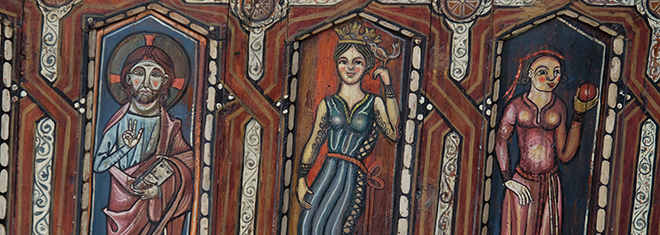
PROJECTE DANAEM
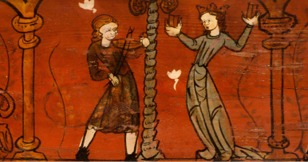
PROJECTE HECO
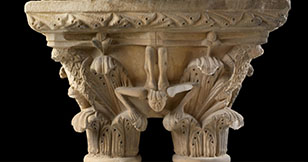
PROJECTE MUDANSA
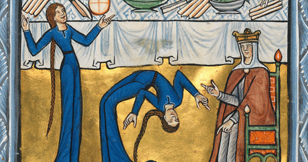
Dancing Women, Idolatry, and Rituals: Visual Culture and Cultural History of Dance in the Long Middle Ages. Acronym MUDANZA, PID2022-140028NB-100
The project "Dancing Women, Idolatry, and Rituals: Visual Culture and Cultural History of Dance in the Long Middle Ages" (Acronym: MUDANZA) focuses on the close relationship established since Antiquity between the female figure and choreutic movements. Regardless of the dance setting, the importance of the dancing female body is evident both in the sacred realm—with dance and heavenly choirs of exaltation and praise to God—and in the imagery that stages idolatry, diabolical rituals, or the perverse use of the body in earthly performances.
As a direct legacy of pagan cults, representations of idolatrous acts during the Middle Ages can be compared with depictions of wild Dionysian worship. In these polarized contexts, the woman is the absolute protagonist of the choreutic act throughout much of the Middle Ages and beyond. Interpreted negatively—as in the case of female minstrels, Salome, or witches—or positively—as in sacred figures who, through dance, achieve ecstasy and reach the vision of God—dancing women, whether literary, allegorical, or even historical, reflect the medieval conception of the body, embodying the social and anthropological vision of the body-dance binomial.
For this reason, the general objective of the project is to highlight this binomial through the study of dance representations featuring female figures in biblical and literary texts, in exempla, and also, among other sources, in biographical and hagiographic accounts of sacred figures and dances within female monasteries. An anthropological approach to the image, together with iconographic analysis of the context in which the dance unfolds, aids in the exploration of the visual culture of the studied period, while a gender perspective allows for the reconstruction of the female imaginary as a central element in medieval choreutic narrative.
Our study is situated within the field of cultural history and visual culture of dance in medieval Europe and its survivals, aiming to offer a new perspective on the role of women as dancing bodies, as typological figures in biblical exegesis, and as key elements for investigating the history of emotions, gesture, and the female body in the Long Middle Ages—understood, following Jacques Le Goff’s approach, as a period that extends beyond the chronological limits imposed by traditional historiography.
Licia Buttà, Universitat Rovira i Virgili, Tarragona (PI)
Adrien Belgrano, EHESS, Parigi e Universitat Rovira i Virgili, Tarragona
Carla Bino, Università Cattolica, Milano
Montserrat Canela Grau, Universitat Rovira i Virgili, Tarragona
Elizabeth Claire, CNRS-École des Hautes Études en Sciences Sociales
Maria Victoria Curto, Universidad Complutense de Madrid
Giulia Di Pierro, Universitat Rovira i Virgili, Tarragona
Lindsey Drury, Freie Universität, Berlin
Isabella Gagliardi, Università degli Studi di Firenze
Francesc Massip, Universitat Rovira i Virgili, Tarragona
Marina Nordera, Université Côte d’Azur, Nice
Alessandro Campeggiani, Université Côte d’Azur, Nice
Donatella Tronca, Università degli Studi di Bologna
Raul Sanchis Francés, Universitat Rovira i Virgili, Tarragona
Maria del Mar Valls Fustè, Universidad Complutense de Madrid